
How Customer Perception Studies Can Drive Product Success in India
Customer perception studies show how buyers really judge a product, and where quality, price, relevance, and trust gaps block success in India.

S VINOTH
Founder of Real Plan Consulting
Why Customer Perception Matters More Than Internal Assumptions
A well-engineered product with a muddled brand story will often lose to a good-enough product that customers clearly understand and trust. This pattern plays out repeatedly across India’s food and beverages, retail, FMCG, and manufacturing sectors.
Customer perception studies go deeper than opinion polls or customer satisfaction surveys. They uncover how your target audience emotionally connects with your product, where they position it against competitors, and which attributes — packaging, price, taste, availability, or service — drive or block purchase decisions. In a market as diverse as India, ignoring customer perception is a significant commercial risk.
What Is a Customer Perception Study?
A customer perception study is a form of primary consumer research that investigates how a product, brand, or service is experienced and evaluated by its intended audience. It goes beyond asking whether someone likes a product: it probes why, how the product compares with alternatives, and whether customers’ perception matches what the company intended to communicate.
What Customer Perception Studies Typically Measure
- Brand image and brand associations
- Perceived versus actual product quality
- Price-value relationship in the customer’s mind
- Packaging appeal and shelf presence
- Purchase triggers and barriers
- Awareness and recall across customer segments
Common methods include in-depth interviews, focus group discussions, ethnographic observation, accompanied shopping studies, and structured questionnaires. No single method tells the full story; together, they show how consumers think and decide.
Common Customer Perception Gaps
Internal assumptions, filtered sales feedback, and complaint data often give companies a distorted picture of their customers. Perception studies bypass these filters and typically uncover four gaps:
- The quality gap: The product performs well technically, but poor packaging or inconsistent retail placement makes it look low-quality.
- The price perception gap: A competitively priced product seems expensive because its value is not clearly communicated.
- The relevance gap: The product is being bought by a different segment from the one it was built for, and the company is unaware of it.
- The trust gap: Customers try the product but do not buy it again because one attribute, such as flavour, texture, or after-sales support, disappoints them.
Identifying these gaps before a national rollout or a major campaign saves money and protects brand equity.
Customer Perception Studies Across Industries
Food and Beverages
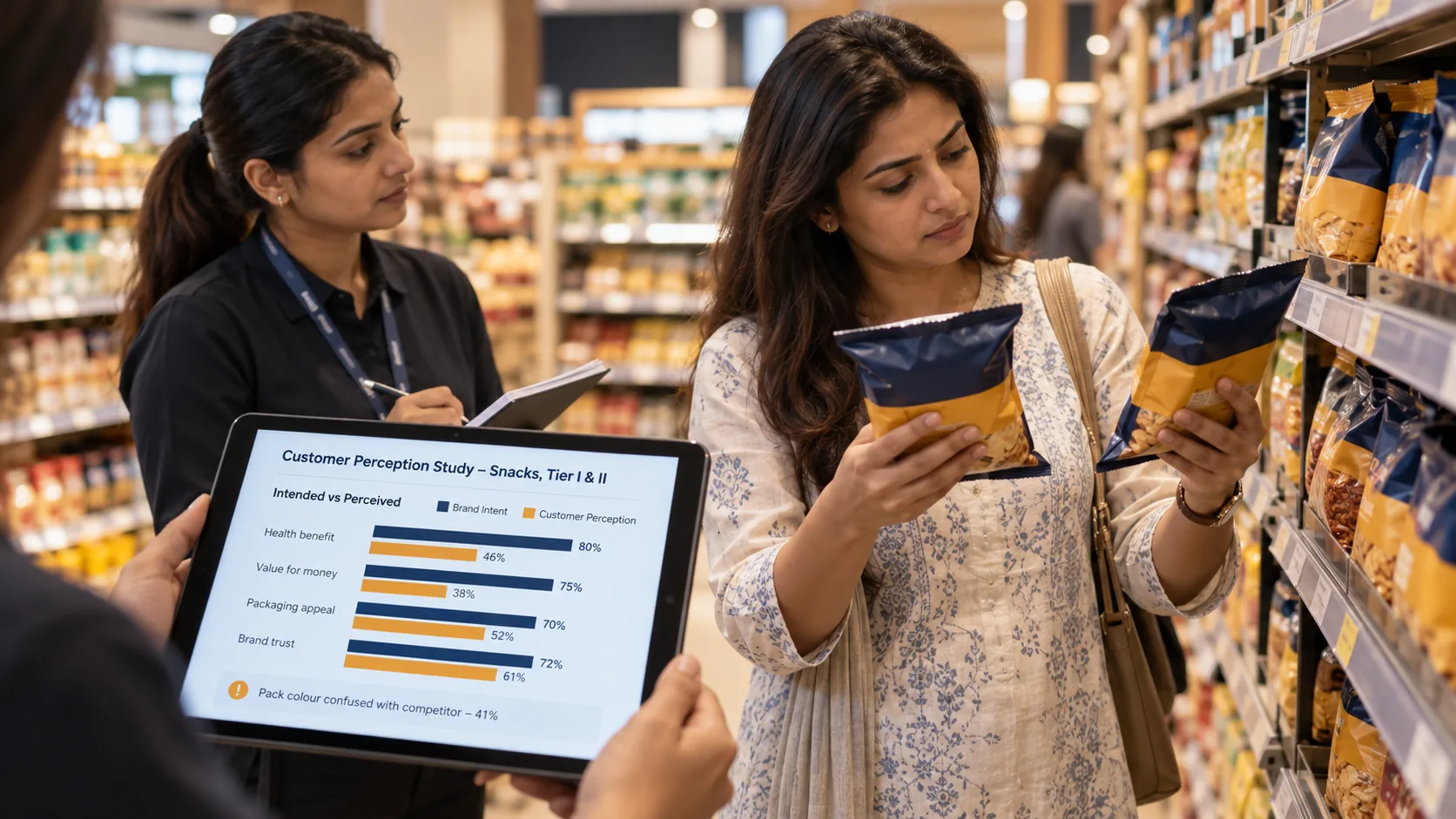
In India’s crowded packaged food market, taste alone rarely decides loyalty; packaging hygiene, brand credibility, and perceived health benefits can matter as much. Consider a mid-sized snack brand entering the health-conscious segment in Tier I and Tier II cities. A perception study could reveal that consumers find it overpriced because they do not see what justifies the price, and that its packaging colour reminds them of a competitor. Fixing these issues before a wider rollout could make a measurable difference to launch performance.
Retail
What shoppers say they want and what they respond to in a store are often very different. Perception research helps retailers refine store layout, product availability, pricing, promotions, and service. If shoppers struggle to find products, a retailer may redesign its layout; online retailers may simplify navigation or returns.
Manufacturing
Manufacturers tend to focus on specifications, but customers judge products in real-world use. A home appliance maker may find that buyers value easy installation and after-sales support as much as performance, while industrial buyers may weigh reliability and maintenance more heavily than price.
FMCG
A household product that sells well in Punjab might face resistance in Tamil Nadu, not because of quality, but because of fragrance preferences, usage habits, or packaging format. Region-specific perception studies help FMCG companies adapt to local realities instead of forcing a single national positioning. Read more about shifting consumer preferences in India’s FMCG market.
How Customer Perception Studies Influence Product Strategy
- Product development: When customers link a product with an unexpected occasion, such as a summer drink that could sell year-round, that is a product opportunity.
- Pricing: Price is a signal. Perception studies show where a price point sits relative to the value customers see, which is critical when launching premium variants.
- Packaging: At the point of sale, packaging can decide trial. Shelf tests and, where available, eye-tracking show which elements attract attention and which confuse.
- Advertising: Pre-testing a TV commercial, digital video, or in-store material shows how the audience reads the message before media budgets are spent.
Challenges in Conducting Customer Perception Studies in India
- Language diversity: Studies run only in English or Hindi miss large parts of the population in states such as Tamil Nadu, West Bengal, or Kerala. Research instruments must be localised without losing comparability.
- Urban–rural divergence: Urban and rural respondents judge quality, value, and trust differently; combining them produces misleading conclusions.
- Social desirability bias: Respondents often say what they think the interviewer wants to hear. Trained moderators and careful design are essential.
- Access and recruitment: Reaching segments such as working women in Tier II cities or rural agricultural households requires established field networks.
Emerging Trends in Customer Perception Research
- Online research communities: Participants share photos, videos, and notes over days or weeks, producing more honest and detailed findings than a single interview.
- Implicit association testing: It measures instant, automatic reactions to a brand before conscious thought kicks in, and is gaining ground in India for brand health tracking.
- Linking perception with sales data: Companies now connect perception findings with sales and CRM records to see whether a shift in perception actually changes buying behaviour.
Key Takeaways
- Customer perception studies reveal the gap between what companies believe and what customers actually experience.
- Quality, price, relevance, and trust gaps are common, measurable, and fixable once identified.
- In India, perception studies must be locally calibrated, not nationally generalised.
Frequently Asked Questions About Customer Perception Studies
How is a customer perception study different from a customer satisfaction survey?
A satisfaction survey measures how satisfied customers are. A perception study explains why they feel that way, how they compare the product with competitors, and what drives or blocks purchase.
When should a business conduct a customer perception study?
Before a product launch, market entry, price change, packaging redesign, or major campaign, and whenever a well-made product underperforms without a clear reason.
Conclusion
Many products fail not because they lack quality, but because they lack alignment with customer perception. Businesses that make perception research a regular part of their product and marketing cycle are better placed to grow in India’s complex markets than those that rely on internal assumptions alone.
Ready to understand what your customers truly think about your product? Real Plan Consulting offers customised customer perception studies and market research solutions across India. Whether you are launching a product, entering a new geography, or trying to understand why a well-made product is underperforming, our research teams can help. Visit www.realplan.in or contact us at connect@realplan.in.
More related blogs

How to Build a Strong Go-to-Market Strategy Using Market Research
How market research shapes each part of a go-to-market strategy: segment, value proposition, price, channel, message, and trade support.

Decoding Shifts in Consumer Preferences in India's FMCG Market
Consumer behaviour in India is reshaping FMCG. Explore market research trends, consumer research insights, and strategies brands use to stay competitive.

The Essential Role of Market Research in Start-Up Success
Learn how to conduct market research for start-ups — from idea validation to market opportunity assessment — and why research is the foundation of sustainable growth.
.aa1fbc66.webp)
.472e3010.webp)
.b585c3ce.webp)
.550b5f97.webp)
.c0585a9c.webp)
.01f95931.webp)
.b31b7b26.webp)
.93a72342.webp)
.d4896d80.webp)
.95ca9319.webp)
.c4c4b939.webp)

.4eaa46ce.webp)