
Optimising Product Launch Strategy with Business Consulting in India
How business consulting and pre-launch research keep product launches in India from failing on price, distribution, and positioning.

RPC EDITORIAL TEAM
Real Plan Consulting

Why Most Product Launches Underperform
A product launch is one of the most capital-intensive decisions a business makes. It requires coordinated investment in development, packaging, pricing, distribution, and communication, often over months or years. Yet many new products fall short of their first-year commercial targets.
The reason is rarely the product itself. Most launches underperform because a good product goes to market with untested pricing, underprepared channels, and communication that has not been validated with the target consumer.
Business consulting brings a structured, research-driven discipline to product launch strategy, replacing internal assumptions with market evidence before capital is committed at scale. This article explains where that support adds the most value, with a focus on Indian businesses.
Common Product Launch Failures and Their Root Causes
Overestimating Market Readiness
Many businesses assume a market is more prepared for a new product than it actually is. Readiness covers awareness of the problem, familiarity with the category, willingness to pay, and access to the right purchase channel. Even an innovative product can fail if the market cannot yet evaluate and adopt it.
Underestimating Distribution Complexity
In India's multi-layered distribution landscape, a product with strong consumer demand can still fail if the supply chain cannot ensure consistent availability. Stockouts at launch can do lasting damage to brand credibility. Trade channel readiness (distributor stocking, retailer shelf allocation, and last-mile logistics) deserves the same rigour as the consumer-facing launch.
Misaligned Pricing
Pricing set without market research is often either too high, limiting trial, or too low, signalling poor quality and eroding margins. Both errors are expensive and slow to correct.
Generic Positioning in a Crowded Category
Positioning that does not clearly differentiate the product gives consumers no reason to switch. Effective positioning connects the product to a specific consumer insight, such as an unmet need or a frustration with existing options, in language the consumer recognises.
Premature National Rollout
Pressure to scale leads many businesses to launch nationally before the product, positioning, and distribution model are validated in a smaller geography. A phased launch (pilot, learn, adjust, then scale) is less dramatic but far more likely to succeed.
How Business Consulting Supports Each Stage of a Product Launch
A consulting-supported launch typically moves through five stages.
Stage 1: Pre-Launch Market Research and Opportunity Validation
Before money is spent on development, research answers a basic question: is there a real opportunity? This means mapping the competitive landscape, confirming with consumers that the problem matters, sizing the market realistically, and checking whether the intended channel can reach the right customer.
Stage 2: Concept Testing and Proposition Development
The product concept is then tested with real consumers rather than assumed to be right. This shows which version and positioning resonate most, and whether the name and packaging work at the point of sale. Where purchase decisions happen in seconds, packaging is a commercial decision, not just a design one.
Stage 3: Pricing Research and Strategy
Pricing research answers three questions: what consumers are willing to pay, how the price compares with alternatives, and which pack-size and price combinations will drive trial and repeat purchase. Trade margins are also modelled so the price works at every level of the distribution chain.
Stage 4: Pilot Launch Planning
A pilot launch tests the complete strategy (product, price, distribution, and communication) in one representative geography. Success metrics are defined before the pilot begins, and feedback from consumers and trade partners allows adjustments while the cost of change is still low.
Stage 5: National Rollout and Post-Launch Tracking
The work does not stop at launch. Awareness, trial, and repeat purchase are tracked by geography and segment, and distribution coverage is measured by volume contribution, not just outlet count. Competitor responses are monitored and factored into the ongoing strategy.
Illustrative Product Launch Scenarios Across Sectors
FMCG: Getting the Sachet Strategy Right
A mid-sized personal care brand launches a new hair care line. Urban consumers in the target segment will pay a premium, but consumers in the same segment in semi-urban markets need a smaller, lower-priced entry point first. Instead of a single national pack, the brand designs a sachet-to-pouch upgrade pathway, which is likely to deliver stronger semi-urban trial than a uniform strategy.
Food and Beverages: Localising Taste Before Scaling
A packaged snacks brand is moving from North India into South India. Regional consumer research shows that flavour and spice expectations differ significantly from its existing range. A regional variant is developed and tested before launch, avoiding a costly reformulation later.
Manufacturing: Dealer Readiness as a Launch Prerequisite
A building materials manufacturer is preparing a new product line for Tier II and Tier III markets. A dealer readiness assessment reveals low product awareness and knowledge gaps among dealer staff. A dealer training programme is rolled out first, so the channel is ready to sell when advertising brings customers in.
India-Specific Product Launch Considerations
Geographic Sequencing
India's size and diversity mean that the order in which markets are entered matters as much as the launch plan itself. Entering a convenient market first, rather than a representative one, can produce misleading data. Sound sequencing, supported by location analysis, weighs market representativeness, distribution readiness, competitive intensity, and logistics together.
Vernacular Communication Testing
Communication that works in English or Hindi may not work in regional languages without adaptation. Testing it with native speakers in the target market is essential wherever regional-language preference is strong.
Regulatory and Compliance Preparation
Categories such as food (regulated by FSSAI), health, agrochemicals, and pharmaceutical-adjacent products need clearances that can vary by product claim and, in some cases, by state. Mapping these requirements early prevents costly delays after launch.
Key Takeaways
- Most launches underperform because of weak market understanding, not product quality.
- Consulting adds evidence at every stage, including a structured pilot with defined metrics.
- Pre-launch research on consumers, positioning, pricing, and channels is among the highest-return launch investments.
- Launch plans for India must account for geographic sequencing, vernacular communication, regional taste, and regulation.
Product Launch Strategy: Frequently Asked Questions
What does a business consultant do in a product launch?
A consultant replaces assumptions with market evidence by validating the opportunity, testing the concept and packaging, researching pricing, planning a pilot, and tracking performance after rollout.
Should a product be piloted before a national launch in India?
In most cases, yes. A pilot in one representative geography tests the full strategy while the cost of change is still low.
Conclusion: Launch on Evidence, Not Assumption
A well-executed product launch is not primarily a marketing event. It is the result of a research-driven process that begins months before the product reaches the shelf.
Business consulting brings the research capability and cross-sector experience that transform launches from high-risk bets into informed commercial investments. In India's competitive market, where the window for correction is narrow, that discipline is not a luxury. It is a commercial advantage.
Planning a product launch and want to get it right the first time?
Real Plan Consulting supports every stage of a launch with market feasibility studies, consumer research, concept and pricing research, channel and dealer research, and location analysis. With 10+ years of experience, we help FMCG brands, manufacturers, retailers, and start-ups across India build launch strategies grounded in evidence.
Contact us to discuss your next product launch.
More related blogs

The Role of Market Research in Business Expansion in India
Why expanding across India needs dedicated market research, and a five-step way to size demand, consumers, competitors, and distribution first.
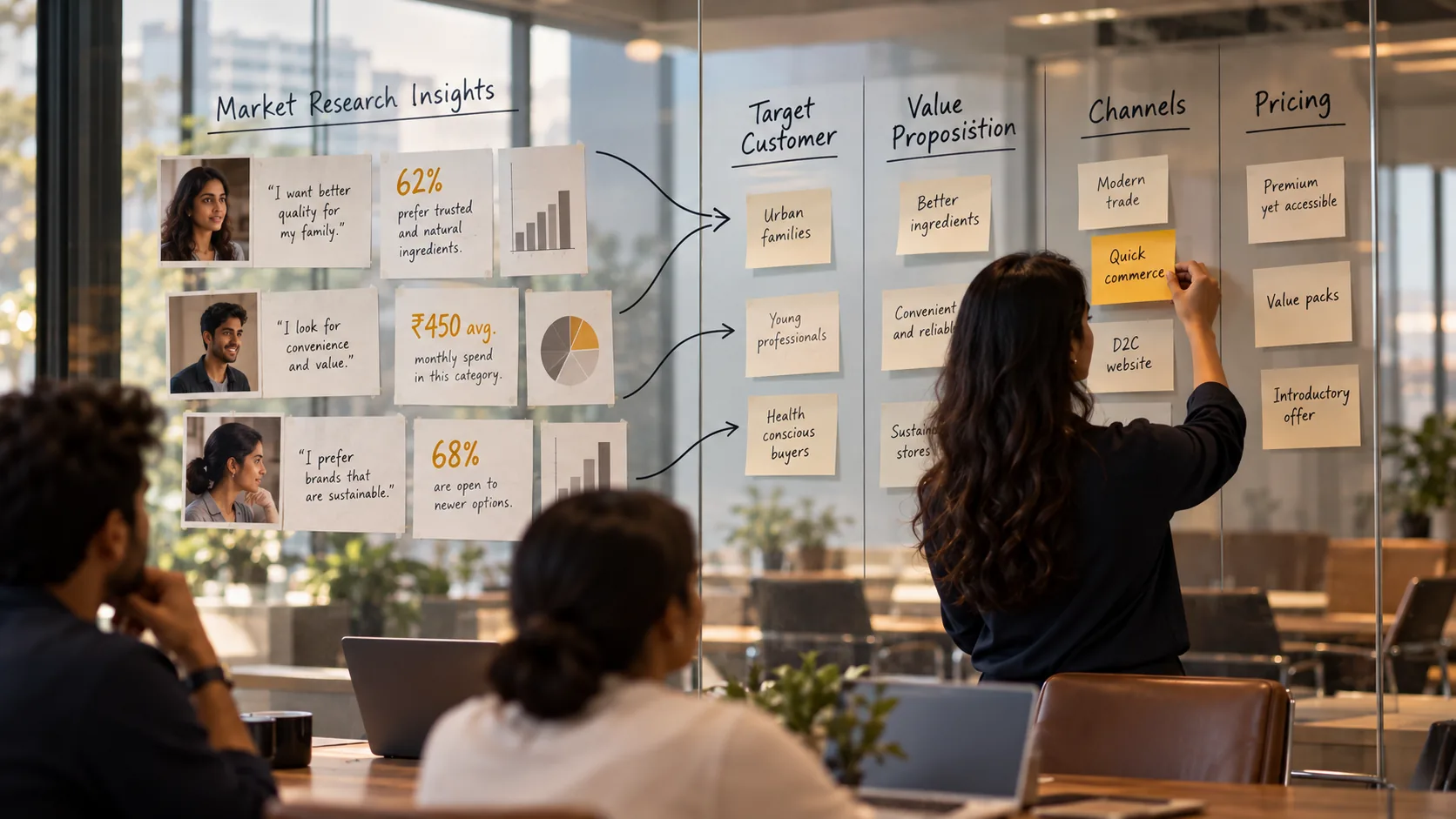
How to Build a Strong Go-to-Market Strategy Using Market Research
How market research shapes each part of a go-to-market strategy: segment, value proposition, price, channel, message, and trade support.

Decoding Shifts in Consumer Preferences in India's FMCG Market
Consumer behaviour in India is reshaping FMCG. Explore market research trends, consumer research insights, and strategies brands use to stay competitive.
.aa1fbc66.webp)
.472e3010.webp)
.b585c3ce.webp)
.550b5f97.webp)
.c0585a9c.webp)
.01f95931.webp)
.b31b7b26.webp)
.93a72342.webp)
.d4896d80.webp)
.95ca9319.webp)
.c4c4b939.webp)

.4eaa46ce.webp)